
#60 October 1, 2024
For some reason, we received six jobs in Portugal that overlapped with each other, and the decision was made to hold an exhibition called Kengo Kuma & Portugal at the Hillside Terrace. One of these six projects was at the Carouste Gulbenkian Museum in Lisbon where the architect Álvaro Siza held a large-scale exhibition. I designed the new building, which will open in September. The wooden furniture manufacturer that produces the furniture designed by Álvaro Siza asked me to design wooden furniture, and I designed a pair of cute chairs like brother and sister kittens, and named them AITAI. I had wanted to see Siza for a long time, and visited his office in Porto to show him my furniture.
In consideration of his age (91), I had planned to only stay for 10 minutes, but we had a very lively conversation which lasted for two hours, and it was so interesting that I was tired from laughing. In addition to gaining a better understanding of Siza as an architect, I also deepened my understanding of the perspectives of Portugal as a country on various issues.
The foremost theme for the architectural world in the latter half of the 20th century was clearly the homogenization of the world by modernist architecture, and how to accommodate the characteristic qualities of the traditions in each locale. I feel that the countries of Japan and Portugal which are located at the eastern tip and western tip of the Eurasian Continent are the countries where this issue was raised at an early point in the 1950s, and the most serious response was made to this issue. In the 1980s and after, it appears that the answer to the difficult question of globalism verses localism was easily addressed and the issue was ended. People appear to have forgotten the superficial American answer to the difficult issue of globalism verses localism. However, Siza at the western tip of the continent continued to resist the trend to allow this issue to fade away into oblivion and stop thinking about it. Mature fans of architecture have watched his achievements while breathing out sighs and feeling respect.
What made these actions sustainable? What was the secret behind them? I feel that the very recent passing of Fumihiko Maki, an architect at the eastern tip of the continent in the same generation as Siza who shared the same goals, brought into closer focus to me the special characteristics of Siza as an architect.
Siza has been supported by art and humor. He emphasized how important art was to him during our two-hour conversation. He told me about an episode in his life when he gave up on his desire to become a sculptor because his father said “Bohemians are no good”. He also told me a sad episode about losing his beloved wife at the age of 32 who had an enviable level of talent as an artist.
The point in the two-hour conversation that was full of humor at which we talked about the emperor of Japan in particular made me laugh uncontrollably.
Art and humor have the power to rescue people from difficult problems that they confront. Maki was a humorous person, and Arata Isozaki who died in 2022 before Maki had a deep connection with art. Siza has both of these qualities, and he faced the difficult issue of modernist architecture, and has transcended this issue.
The thing concerning Siza that was on my mind was the sarcastic statement by Souto de Moura, Siza’s pupil. Souto de Moura compared Siza and the Portuguese architect Fernando Távora who was Siza’s mentor and one of the first in the world to criticize modernism, stating “Siza played the role in the script written by Távora”. While Souto de Moura was definitely a groundbreaker in criticizing globalism, regrettably, the execution in his work does not deeply strike your heart like the works of Siza.
Souto de Moura said that the reason that Siza’s architecture strikes people in the way that it does is because of the attractive stage provided by Portugal. The living body of an actor is a different name for a person with outstanding talent who is exposed to people on a live stage. Távora did not skillfully use the stage. That is why he did not become an actor. Siza completely utilized the potential of the stage known as Portugal, and brilliantly played his role. Consequently, Siza captured the stage that Portugal represented, resulting in extremely few opportunities for foreign architects to do work in Portugal. It has been pointed out by Portuguese architects that the only exceptions to this are the theatre in Porto built by Rem Koolhaas, and Kengo Kuma.
Why has my architecture has been accepted in Portugal? One reason for this is the fact that Portugal itself is in the midst of a transformation. There is a considerable time-lag with the transformation at the eastern tip of the continent (Japan), but there is active investment that is taking place in Portugal which was a quiet place for a long time, and it is becoming a different country.
However, I feel that the characteristics of this place which is located at the tip of the content are preserved. I guess these resonate with me since I am from the eastern tip. If this is the case, just what kind of characteristics do places at the tip of a continent have?
The tip of a continent is the most remote of places since the only thing that lies beyond is the ocean. Various people and things drift here, but can go no further. Layers of history are deposited in a place like this at the edge of nowhere, and it has been pointed out by folklorists that it is a place where origins are preserved. Both Japan and Portugal are at that type of special edge, and the layers of history that are retained there resist the new layers consisting of modernism that drifted from the center of the continent. I feel that the unique modernism of Japan emerged from the tension of that resistance, and this created Siza’s architecture that has the aroma of the ocean and land. I came to understand this better during my two-hour conversation with Siza. At the same time, the determination to create new things arose within me, taking on the unique characteristics at the edge of the Eurasian continent.

ProjectsThe Morette Memorial
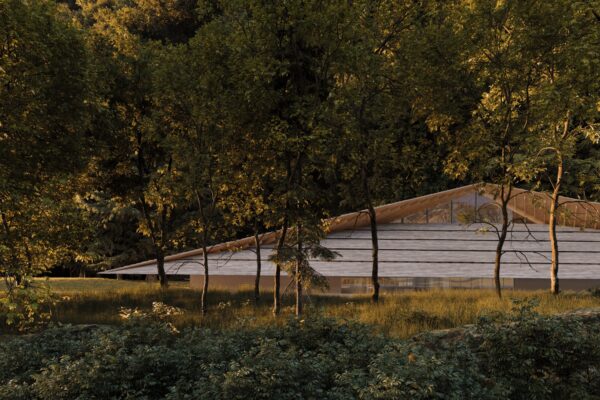 The Morette Memorial is located on the floodplain of the Fier River. Its ecological position lies on the edge of two ecosystems: the plain and the relief. The braided riverine linear of the Fier makes it a true natural infrastructure with high biodiversity. The road, acting as a levee, has stabilize … Read More