
#74 November 10, 2025
Charlotte Perriand's Apartment and Smallness
I visited the small apartment in Paris where Charlotte Perriand once lived. This was the result of the close relationship that my long-term friend Catherine Cadou has with Pernette, Perriand’s daughter. I have seen various types of large and small apartments in my 70 years of life, but I was truly impressed by this apartment, and felt that I had finally encountered the best one of all.
It may be rather surprising, but Charlotte Perriand who was known as a furniture designer and supported the work done by Le Corbusier, is in fact a behind-the-scenes central character in my book Nihon no Kenchiku (Japan and Japanese Architecture) published by Iwanami Shoten (2023). The main theme hidden in the book was a reversal of machismo. This was an attempt at defining Japanese architecture as a form of anti-machismo by presenting various examples of the feminine composition of Japan in contrast to the masculine character of the West.
However, at the same time, there is machismo in Japan as well, and I have for a long time felt a discomfort in the praising of traditional Japanese architecture, since it often has a patriarchal, authoritarian character. That discomfort has made it difficult for me to praise Japanese things unreservedly. Modernist architecture incorporates an element of criticizing traditional Western architecture, but modernism also integrates machismo, and Le Corbusier’s macho modernist structures are representative of this feature. That modernism and machismo became bloated and very rigid, which is something that I found to be unbearable.
Perriand intensively criticized all of these elements of machismo. She loved Japan, where various levels of machismo overlap and are intertwined, but at the same time continued to criticize machismo in a freewheeling manner. She was the harshest critic of Le Corbusier’s machismo, in spite of the fact that she remained close to him, and did not relent in her criticism of machismo that was concealed in the Mingei (folk craft) movement in Japan. I wrote Nihon no Kenchiku as an homage to Perriand, who was thoroughly free-spirit in every sense of the word.
The apartments that were left behind in Paris by Perriand, or more accurately, the two apartments facing each other across the elevator hall, in one sense is a masterpiece that represents the culmination of her ideas. The most charming feature of the apartments, without question, consists of their smallness. The first apartment unit created in 1970 was a 60-square-meter maisonnette. Pernette had once told her mother, “I think the unit is too small and is not suited to you, but the view which is found nowhere else in Paris has a certain value. You should come and see it.” Indeed, Perriand herself wrote in her autobiography, Une vie de création (Charlotte Perriand: A Life of Creation, first published in France in 1998), “the 60-square-meter apartment appeared to be uninhabitable.” And yet, it was transformed by the magic of Perriand into a human dwelling. What is truly a sight to see is a wooden spiral staircase forced into an 86cm x 86cm shaft, with each step measuring only about 40cm wide. Pernette, being petite, climbed the steps effortlessly, and even I, with a larger build, did not have any trouble going up and down them.
In 1994, when the apartment unit across the hall became available, Perriand renovated it into another dwelling and working space. She drew several hundred drawings herself, and threw them all in the garbage when work was completed, but Pernette said she is proud of the fact that she was able to save them at the last minute before they were taken away and lost forever.
Both of the apartments were not only small in area, but all of the elements that comprise them are small and cute. This taught me that a good apartment is, by nature, a small one.
Furthermore, each apartment has a number of small terraces, intricately connecting the intimate interior spaces with the small exterior spaces. For Perriand, the terrace was the most important space in an apartment. In her autobiography (1998), she wrote, “I will create a dwelling where we can sit at a table, surrounded by flowers, enjoying the scent of the evening gentle breeze, and spend nights in this tender ambiance. […] I need to find such a terrace without a roof.”
That day, we were blessed to have the opportunity to spend a blissful time on one of those small terraces surrounded by greenery. Thus, she used the two weapons of smallness and gardens to thoroughly and enjoyably criticize all of the elements of machismo.

ProjectsHouse of Time
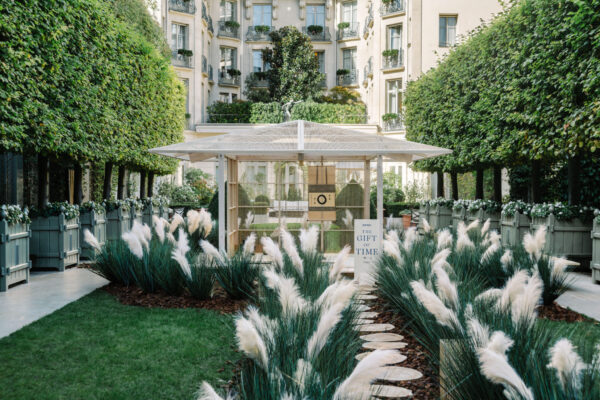 A temporary four-and-a-half-mat tearoom was designed for one night only in the Grand Jardin, the courtyard of the Ritz Hotel facing Place Vendôme in Paris. No nails, bolts, or other metal fasteners were used; instead, all the components were joined using the traditional Japanese Kango (interlocking) … Read More
ProjectsMt.Fuji Residence
 The villa was designed to overlook Mt. Fuji. The basic rule of KKAA is that the eave lines of a pitched roof should be aligned to avoid any difficulties with fitting due to the difference in eave height. Example: Portland Japanese Garden. However, this rule has a weakness in that it makes it difficu … Read More
Projectsfenua
 On the seashore of Oshima Island in the Seto Inland Sea, a place known for the beauty of its many islands (Tato-kai), we designed a quiet French restaurant that blends in with its environment using local stone (Oshima stone) and wood. Impressed by the coarse expression of the local quarry, uneven su … Read More