
#86 June 15, 2026
My First Exhibition of Sketches
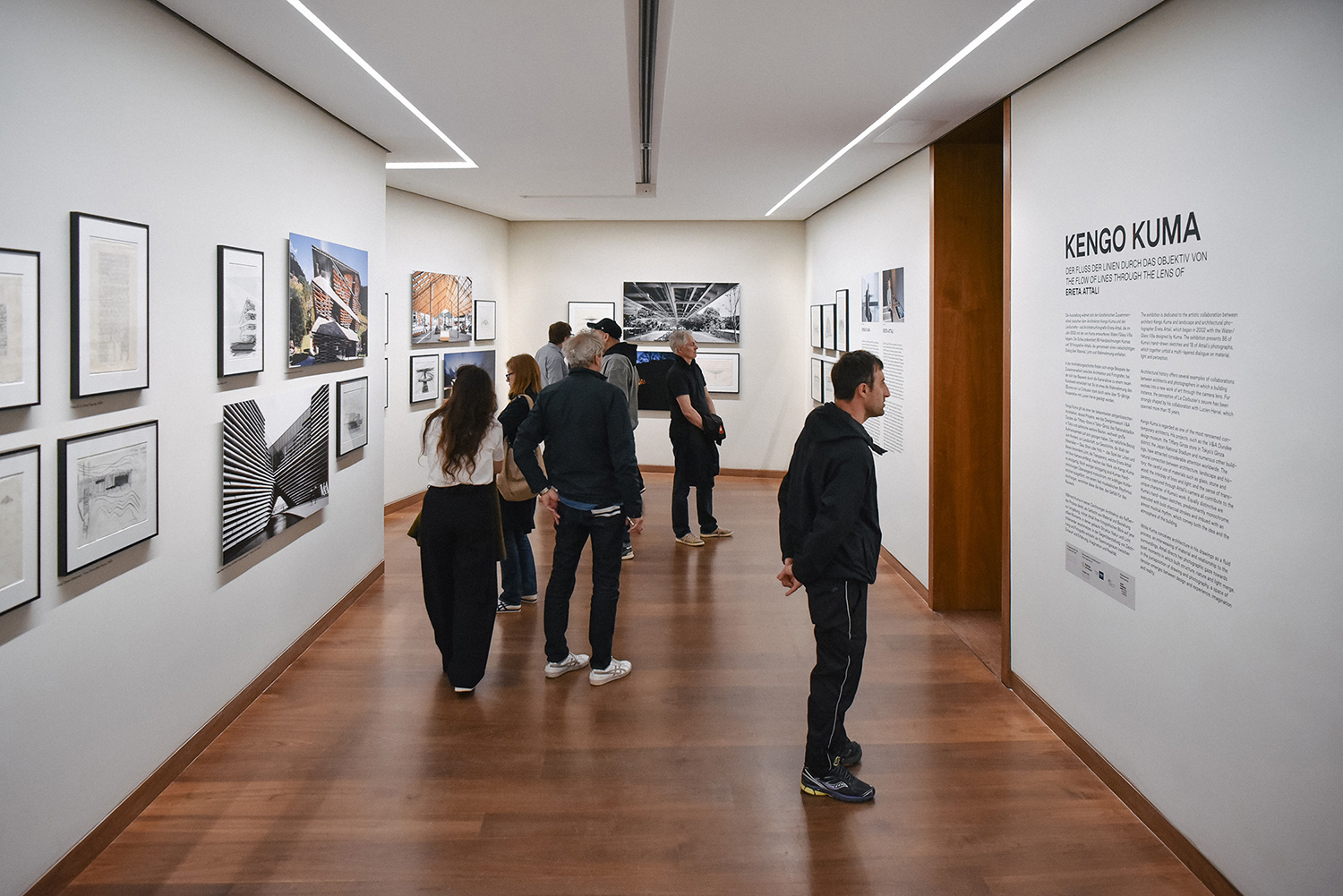
An exhibition dedicated to my sketches has opened for the first time at the Tchoban Foundation in Berlin. While I have held countless photography and model exhibitions around the world, exhibiting hand-drawn sketches made me feel as if I were exposing my raw physical self, making me much more nervous than when holding typical exhibitions.
The exact title of the exhibition is "Kengo Kuma – The Flow of Lines through the Lens of Erieta Attali." It is a unique combination that places my charcoal sketches alongside the work of Erieta Attali, a photographer who has been capturing my architecture for a long time.
 © Ansgar Koreng / CC BY-SA 3.0 (DE)
Even I was surprised by the sheer number of sketches on display. Since I draw sketches to confirm the inner rhythm of my architecture, my desire to check this rhythm and engrave it firmly onto paper is uncontrollable, which is probably why such a vast number of sketches accumulated without my noticing.
The phrase "architecture is frozen music" is famous as the words of Goethe, but music is a mix of various elements. I have little interest in harmony, the proportions underlying it, or melody, which is often considered the main part of music. My focus is entirely on tone and rhythm. This interest awakened during the 1990s, after the economic bubble burst, when I spent time wandering through rural areas. Looking back, the architecture I created in rural areas during that difficult period, which now feels like a kind of dream, was extremely low-cost and small in scale, leaving absolutely no room to play with silhouettes or manipulate volumes, so I focused solely on what kind of rhythm I could create within a minimal volume. A key example from this era is the Stone Museum built in 2000. I devoted all my energy to finding out what kind of rhythm I could play using only the arrangement of stone pieces and the placement of openings. I discovered rhythm as a method during this period, and in that process, I began to draw clumsy sketches because I wanted to engrave the rhythm embedded in the architecture onto paper.
At the beginning of the 1990s, I severely injured my right wrist. I could no longer use my right hand freely, and I lost the ability to draw lines skillfully as I had done before. This personal circumstance also led to the creation of these clumsy "sketches of rhythm." A kind of "difficult period" and a personal injury conspired to give birth to these "sketches of rhythm."
 © Nadja Fedorova
Erieta's photographs were displayed next to my sketches. Her photos are different from typical architectural photography. They do not capture architectural volumes or silhouettes. Instead, she captures the atmosphere of the architecture on photographic paper.
Erieta commented at a later symposium that she discovered this method when she started photographing my architecture. She was not originally an architectural photographer, but had been taking photos of landscapes and ruins. She saw my early work, Water/Glass completed in 1995, in the Columbia University library. She felt a strong desire to photograph it, which led her to enter the world of architectural photography. She immediately consulted her mentor, Kenneth Frampton, a professor at Columbia University. He told her that he strongly encouraged her to go to Japan, but warned her that it was far away.
Erieta had no interest in form, which is usually tied to architecture. This is probably what attracted her to my architecture, as I also disliked form.
 © Nadja Fedorova
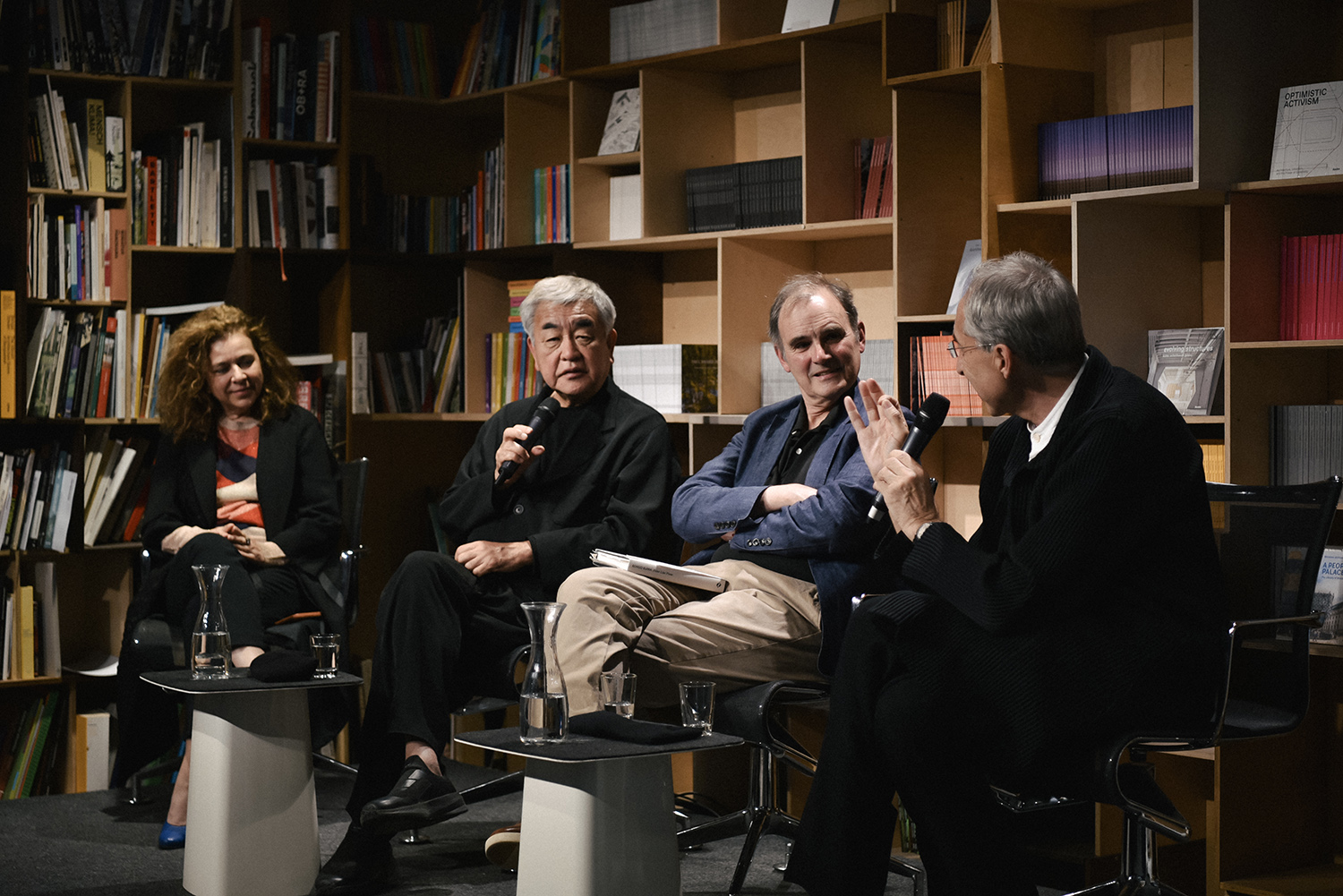
Erieta's photographs always capture atmosphere and relationships so beautifully, and that is why I admire them. Regarding the relationship with Berlin, where this exhibition is held, Bruno Taut, who moved from Berlin to Japan in 1933 to escape the Nazi regime, wept when he saw the Katsura Imperial Villa, and he remarked that columns are the architecture of relationship. Water/Glass, which moved Erieta so deeply, is located on the land next to the Hyuga Villa built in 1936, which is the only architecture Bruno Taut left in Japan. I designed Water/Glass as a tribute to Taut. I wanted to turn the relationship between water, specifically the Pacific Ocean, and humans into architecture using glass as a medium. It was a truly special moment, as if Taut, Erieta, and I were finally brought together with Berlin acting as our pivot.
The event was moderated by Barry Bergdoll, a professor at Columbia University and one of the finest architectural critics of our time. In a past dialogue in New York, he commented that just as the architecture of Le Corbusier is inseparable from the photographs of Lucien Hervé, my architecture might be inseparable from the photographs of Erieta. Hervé used strong shadows to beautifully present Le Corbusier's works as three-dimensional sculptures. I finally understood the meaning of that comment in Berlin.

NewsExhibitionKengo Kuma – The Flow of Lines through the Lens of Erieta Attali
 We are pleased to announce that the exhibition “Kengo Kuma – The Flow of Lines through the Lens of Erieta Attali” will be presented at the Tchoban Foundation – Museum for Architectural Drawing. [Exhibition Details] Exhibition Title: Kengo Kuma – The Flow of Lines through the Lens of Erieta Attali Da … Read More
NewsKengo Kuma Documentary Film “particle dance”to Screen in Chiba
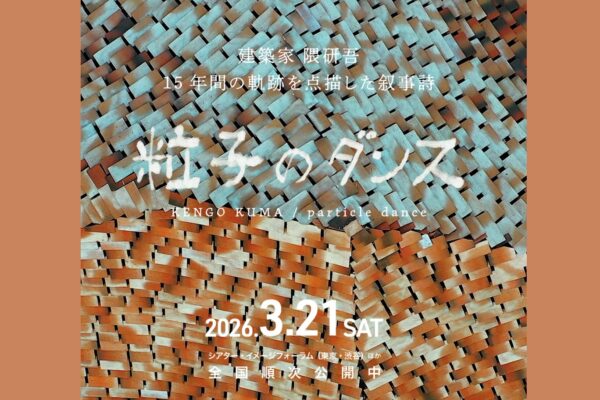 The film "Dance of Particles" will be screened at Kinema Junpo Theater in Kashiwa, Chiba Prefecture. Screening period: June 6–12, 2026. For further details, please visit the Kinema Junpo Theater website. Nationwide release to follow. Screening schedules vary by venue. For the latest screening infor … Read More