
#69 May 27, 2025
Louis Kahn and Me
I recently went to three cities on the East Coast in the United States and gave lectures since there was an opening in my schedule. This was my first visit to Harvard since 2019 due to the impact of the Coronavirus pandemic, and it made me a little sad to find out that the number of students from Japan had continued to decrease. There, I talked about my latest work based on the themes of environmental problems and natural materials.
At Columbia University in New York, the entire campus was locked out due to problems with Trump, so we hastily changed the venue to the Asia Society in midtown. Since I have a policy of not giving lectures on the same theme, I talked about loose clusters of particles that are made possible by computational design. That is to say, I talked about organic design of particles. Columbia University has made parametric design a central part of its education since the latter half of the 1980s, when I was a visiting scholar there. So, I attempted to analyze my recent architecture from a perspective that fits with that.
On the third day, an award ceremony for the Louis I. Kahn Award, which I was given, and a commemorative lecture were held at the Penn Museum in Philadelphia.
Louis Kahn (1901 – 1974) is an American architect whom I adore and hold in the highest esteem, along with Frank Lloyd Wright, and the fact that I received an award that is named after him is something that is very special for me among the various awards that I have received.
The thing that Wright and Kahn have in common is the fact that while they were American architects in the 20th century, they both severely and harshly criticized 20th century American civilization. Their criticism of American civilization for which the scale and speed was expanding and accelerating using the weapons of concrete and steel became the driving force for my architectural activities. I learned the attitude that I wanted to have from the two Americans. Furthermore, both of them pursued activities in locations other than America, such as Japan and Bangladesh, and I admire their width of expression and ways of living that they attained while learning and borrowing the power of the locations in stark contrast to America. I have used their activities as a paradigm for my activities overseas. At the ceremony and lecture, I included these personal thoughts and expanded upon them when comparing my architecture with the architecture of Louis Kahn.
The first image that I showed was the Norman Fisher House (1967), which is my favorite work by Kahn which has a plank outer wall. I started talking about the fact that family-oriented intimacy is the basis of architecture by Kahn. I used planks at the Japan National Stadium in Tokyo to play the leading role with the same dimension (width of 105mm) in a repeating pattern. The deep impression made upon me by the Norman Fisher House was definitely in the background for my efforts to have planks play the leading role of the entire architecture, the basic unit for wooden houses, in a huge stadium with a capacity of 80,000.
The National Assembly Building of Bangladesh, designed by Kahn and completed in 1982, is also an unforgettable piece of work for me. When you observe the structure up close, you can see from the details and the surface that the level of construction in Bangladesh at the time was rough and uneven, but there is a strength that transcends these details. Rather than being beautiful in spite of being rough, the overall appearance was sublime and moving because of its roughness.
The model that I always use when working on projects overseas where the high building quality available in Japan cannot be achieved is the model used by Kahn in Bangladesh. The existence of this model has continued to encourage me, as well as provide hints on the very method of mine that I can use to integrate roughness and nobility.
I learned a lot of things from the way Kahn lived at a time when American civilization and wealth were at their peak from the fact that he dared to go to places like Bangladesh and India, and left important pieces of work, through which he criticized American civilization.
Unexpectedly, I received a standing ovation when I finished my talk. This surprised me so much that tears would not stop flowing from my eyes. I was told that this was the first time something like this happened at the ceremonies of this award.
Kahn collapsed and died in Penn Station in New York on his way back from Bangladesh, and was found as an unidentified person. I promised myself that I would like to continue running from one project to the next like this until the very end.
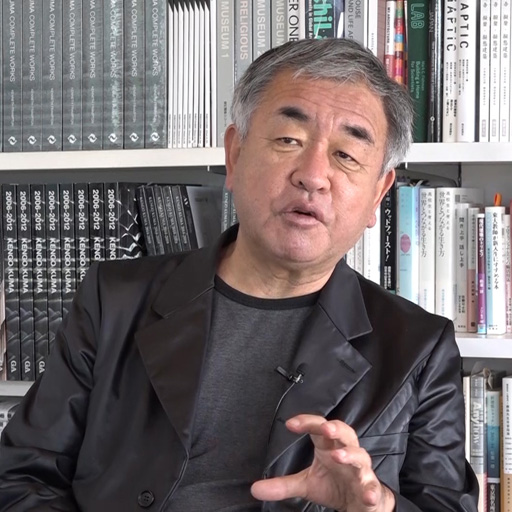

NewsAward / Event Information- 2025 Louis I. Kahn Award
 Kengo Kuma will receive the 38th Louis I. Kahn Award, presented by DesignPhiladelphia, and will lecture at the ceremony. 2025 Louis I. Kahn Award + Talk Honoring Kengo Kuma Venue: Penn Museum , Philadelphia Date: Wednesday, April 9, 2025, 5:30 PM - 8:00 PM For more information, click here. Organized … Read More