
#61 October 1, 2024
Seigow Matsuoka, who had a considerable influence on me since I was a student, and continued to interact with me in various ways over the years, has passed away. In particular, in the last 10 years, we worked together very closely on starting up the Kadokawa Culture Museum in Musashino and the Omi ARS Project which was formulated to stimulate the Biwa area centered around Lake Biwa. The time that we spent together is something that I will treasure for the rest of my life, and I will cherish and rejoice in this experience.
There are a number of moments that are truly unforgettable. One of these is the extraordinary focus of Seigow Matsuoka on the bookshelves and lighting when we worked together on the design of the “Bookshelf Theater” at the Kadokawa Culture Museum. In general, when a person like Seigow Matsuoka in the literary world collaborates with an architect, the author gives the architect a concept, and the individual details are left up to the architect.
However, Seigow Matsuoka adopted an approach which was the complete opposite of this. His thoughts started with the details of the shelves that hold the books. His far-ranging long-term concepts of the appropriate forms of libraries and other cultural facilities of the future began with the shape of the edges of the small shelves that first come into view. The shelves are cut off and staggered (diagonally), looking like they are wandering around, floating in space.
Why do book shelves need to be staggered? Matsuoka explained the reason by quickly scrolling the screen with his right hand while holding his smart phone with his left hand. The edges of the shelves that are cut off and randomly intersect correspond to the speed and rhythm of this scrolling.
I was mesmerized by his explanation of the form of libraries of the future in which the movement of the body and activity in the brain materialize, and the shelves cumulate in a limitless manner like the clouds in the sky. The beauty of his scrolling the screen was even more like theater than the explanation itself.
The reason that this looked theatrical to me may consist of the fact that I had heard that Matsuoka was in the Theatre and Film Arts Department at Waseda University.
It is interesting to note that Matsuoka was in charge of the lighting, and continued to silently work on how to illuminate the actors (books), and what kind of light to provide on the stage.
I feel that this focus is the essence of a great thinker like Seigow Matsuoka who is very rare. I also have a special interest in and passion for how objects are illuminated in my own architectural methods. That is why I had deep empathy for the episodes while Matsuoka was in the Theatre and Film Arts Department, and the sense of closeness that he emanated further strengthened this feeling.
His approach of using light to enter the world of light provides a large hint when thinking about how Matsuoka interacted with the world. First of all, Matsuoka felt that the world was a dark place. From that perspective, he was a profound pessimist. However, this does not mean that people are unhappy. He thought that people had the infinite freedom to facilitate the advent of many things by bringing light into the world.
The deeper the darkness, the larger the level of freedom, and the greater the level of happiness. The important thing in theater is the fact that the stage is something that is extremely small compared to the world which is a gigantic place. The perspective that he knew the stage was small further deepened the pessimism of Matsuoka. However, this smallness entails the freedom to enable the emergence of virtually anything. Matsuoka definitely discovered this paradox while being involved with stage lighting.
I share that way of thinking. This consists of the sharing of the polymerization of pessimism and optimism. The stage that consists of architecture in which I am involved is no more than an insignificant crevice that is surprisingly small when perceived within the huge amount of darkness in the world. However, I have infinite freedom since I am enveloped in that small darkness. I can proudly state that this is my world view to people, represented by the things that emerge.
I believe that this is the essence of architecture, and the essence of theater. The sharing of this awareness by Matsuoka-san and myself made it possible for us to continue to interact in such an enjoyable manner. Matsuoka-san devoted his life to realizing these tiny possibilities. I’m also dedicating my life to the same cause.

ProjectsAudeum (audio museum)
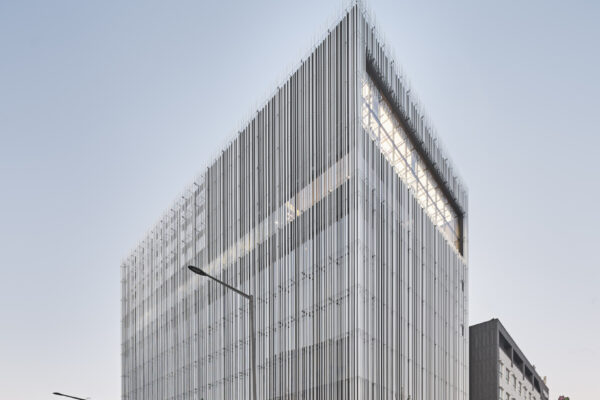 The Audeum (Audio Museum), located in Seoul/Gangnam, is a museum that goes beyond the traditional concept of a museum. It is a place where you can not only see but also experience sound firsthand. Moreover, it is not just a place to listen to sound; it is an architectural instrument that returns hum … Read More
ProjectsAkane
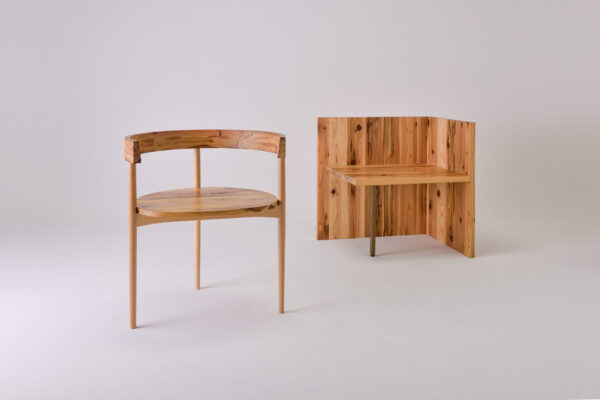 We designed furniture using wood from Kishu, Wakayama Prefecture, one of the centers of Japan's forestry industry which has a unique origin: Akane-wood. Akane-wood is wood that has been eaten by the larvae of “Suginoakanetorakamikiri”, a Japanese cedar woodpecker and is often discarded as defective … Read More