
#80 March 14, 2026
My Impression on “Hard-Boiled Wonderland and the End of the World” Play
I first met Haruki Murakami at the Hans Christian Andersen Museum in Odense, Denmark, 10 years ago in the fall of 2016. This encounter in Odense was the starting point for various things, including the Haruki Murakami Library (2021) at Waseda University which we designed.
The ceremony at which Haruki Murakami was awarded the Hans Christian Andersen Literature Award was held at the museum next to the small house where Hans Christian Andersen was born. I was selected as the architect to rebuild this museum in a competition two months before this, and was invited to the award ceremony.
The speech that Haruki gave was different from anything that I had ever experienced, causing me to quiver with emotion.
Haruki sharply analyzed the essence of Andersen’s literature, pointing out that there is a shadow in its essence, and that stories which do not have a shadow do not reach a deep place in people's hearts. He asserted that light in a world without shadows was very shallow.
This speech was a deep commentary on literature rather than a greeting at an award ceremony, becoming a piece of work in and of itself. The venue was filled with emotion, and there was a huge round of applause.
As a child, I often wondered why Andersen’s books always had such hopeless endings in spite of the fact they were fairy tales, and was curious why good and evil could not be simply divided. When Haruki pointed out that all of these elements were a reflection of the sincerity of Andersen with respect to shadows, I was awakened to the truth, and clearly saw what was most needed in the New Hans Christian Andersen Museum which we were designing.
I felt that this would result in a new vision and large amount of hope arising from inside me, where shadows would play the leading role in the architecture that I create. I think that if I had not heard this speech, my life would have been headed in an entirely different direction, and my architecture would have taken a different form.
Tonight, I enjoyed the “End of the World” play on stage based on the theme of shadows. Whether due to the lighting or the makeup, the actor playing the shadow was undoubtedly there, yet I could not discern any expression or texture at all. In that sense, they were mysteriously invisible.
In the same manner as for shadows, the walls are extremely vague, and you cannot tell whether they are something that is real or an illusion. The walls that surround the Town in the story where the protagonist lives were also a mysterious fluffy drifting presence that were made from see-through fabric. My 50-year struggle as an architect to make the presence of walls as tenuous as possible was expressed so accurately and openly on stage that I was stunned.
In the commentary on the play, Shinichi Fukuoka noted that for Haruki, shadows have a deep connection to his heart, and walls also have a deep connection to his consciousness. Fukuoka clearly explained that Haruki depicts our world, torn between consciousness (logos: logic and reason in rhetoric) and the heart (physis: nature & origin [life]), as a parallel world inhabited by two entities, "Watakushi" and "Boku." Haruki expresses the difference between these two parallel worlds using the two types of I in Japanese, Watakushi (formal) and Boku (informal, normally used by males), but it is nearly impossible to translate into English since “I” is the translation of both words. There is a famous episode about the translator Alfred Birnbaum using the past tense for the world of Watakushi and the present tense for the world of Boku when he encountered this difficulty. This was a great invention which will remain in the history of translation, showing that the subtle difference in the sense of distance between subject and object can be expressed through the medium of tense.
I asked Alfred Birnbaum to translate my two-volume set of essays Chiisana Kenchiku (Small Architecture) / Shizen na Kenchiku (Natural Architecture) (2015, AA Publications). There are many stories in these two volumes about how it feels like small vague architecture disappears into shadows. Birnbaum brilliantly expresses in English my contradictory desire to create semi-transparent walls which are so fluffy, drifting, and vague that they disappear into the shadows.
Today’s performance on stage brought back various memories, and caused me to think about logos and physis. When we design architecture, we depend to a large extent on logos, but once the architecture is completed, it reaches people through the medium of physis. In that sense, both architecture and cities are torn apart by logos and physis. And because they are torn apart, architecture serves the significant role of connecting the past and the present, as well as construction and phenomenon.
My imagination about the architect and the recipient of the building, and about architecture and time, expanded one after another through the tool of tense discovered by Alfred Birnbaum. This was truly a rich theatrical experience.

ProjectsThe Waseda International House of Literature (The Haruki Murakami Library)
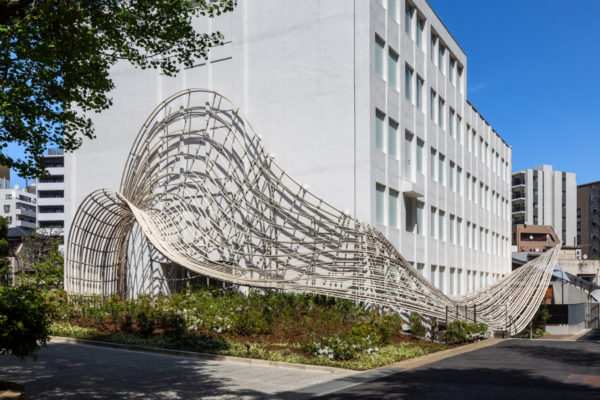 We renovated the Waseda University Campus Building #4 into the new Haruki Murakami Library as a “wooden tunnel” that penetrates through the existing building. The wooden tunnel transcends time and space, as we translated the “tunnels” in Murakami’s novels that connect different dimensions into archi … Read More
ProjectsNew Hans Christian Andersen Museum
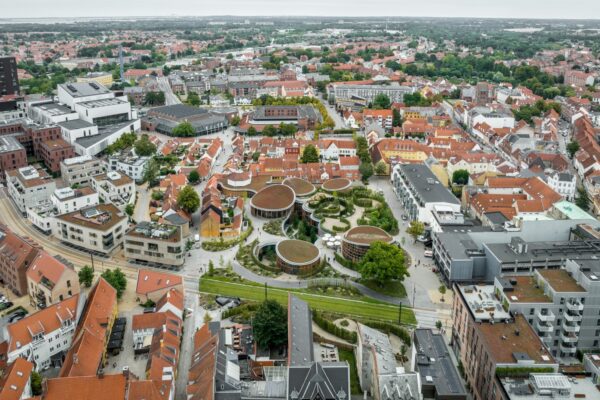 The project is to create a new building for the H.C. Andersen museum, the garden and Tinderbox cultural center in the heart of the city where Andersen was born. The site is located in between the residential area with small traditional wooden houses from the middle age and the newly developed urban … Read More