Subscribe
Your Information
Welcome to our Newsletter!
Please enter all the fields in this form.
Newsletter Example

#79 February 23, 2026
Val di Fiemme and the Living Cycle of Forests
Inside a 12th-century building in the quiet valleys on the Italy-Austria border, I held a small seminar and talked with the locals.
Until I went there, I didn’t really know what kind of place the Fiemme Valley was. It had to do with the Domino 3.0 wooden pavilion we designed last year for the Venice Biennale. The pavilion was later moved to a garden in this valley for exhibition, which used to belong to a lord’s house there. I was invited to come and see it, possibly with a talk session and even an exhibition there.
I thought I would deserve some relaxation once in a while in the snow-covered mountains of Italy, but after talking with the locals living in the forest, I realized that there was a deep inevitability behind my being called here, not just coincidence.
At the end of the valley to the west is the town of Bolzano, where, twenty years ago in 2006, I held my very first lecture in Italy. The valley connecting Bolzano to Fiemme is a sort of sacred place for Italian forestry, and the people living there working with timber got interested in my Hiroshige Museum completed in 2000, and invited me, who was still an unknown architect. At the seminar I happily reunited with the people from back then, expressed my gratitude from twenty years ago, and thanked them again for carrying and assembling the Domino from Venice this time, toasting with the valley's red wine.
I also learned that there is a clear reason why they have such an interest in wooden architecture. In the Fiemme Valley, the forest is essentially not privately owned but a communal asset. To ensure that this resource does not become depleted and remains a treasure of the community forever, strict rules have been applied to its logging. I also heard a remarkable story that this well-planned and sustainable method of logging gives the fir trees of the valley, known as "resonance firs," a special quality. Stradivarius and Guarneri violins, which are at the pinnacle of classical music, were made from these "resonance firs" that produce their special tone. It means that only the special fir trees of this special forest were producing a sound that resonated throughout the world. The management of this logging was meticulous, based on the phases of the moon, closely resembling the methods used for harvesting bio wines in recent years.
The strict management of this forest by the commune is often compared with the traditional management of Satoyama forests in Japan, often pointing out that the Italian approach is quite different from Japanese Satoyama, which, being privately owned, is seriously degraded.
In Japan, I am fortunately connected with the forest in the remote mountains of Yusuhara in Kochi, and another amazing bond was added in Italy this way. In a valley not far from Milano Cortina Olympic ski slopes, I was able to reflect deeply on forests and human beings.


NewsExhibitionDomino 3.0 From Wound to shape. Kengo Kuma and Regenerative Architecture
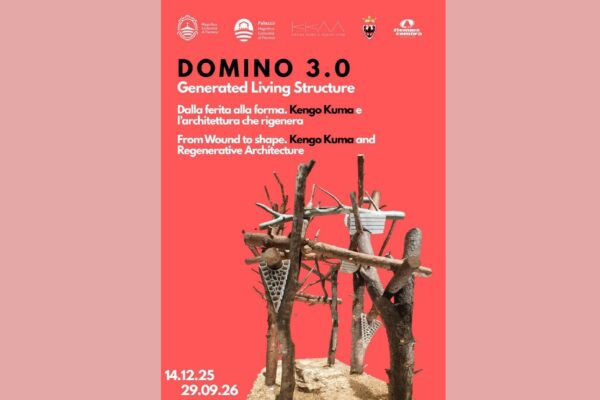 We are pleased to announce that Domino 3.0 / Generated Living Structure, which was exhibited at the 19th International Architecture Exhibition of La Biennale di Venezia, will return to the region where its timber was sourced and be re-exhibited at “Domino 3.0 Dalla ferita alla forma. Kengo Kuma e l’ … Read More
ProjectsDomino 3.0 / Generated Living Structure
 For the Venice Biennale International Architecture Exhibition 2025, held under the overarching theme of AI, we presented Domino 3.0: a house to return to the forest. The material was timber from trees uprooted and devastated by Storm Vaia in October 2018 — trees left to decay on the forest floor. Ea … Read More
NewsEventItalian Design in Japan (IDJ) Masterclass
 Kengo Kuma will speak at the Italian Design in Japan (IDJ) Masterclass, held at the Casa del Design Italiano, located at the Embassy of Italy in Tokyo. The event is by invitation only and will also be live-streamed on YouTube. YouTube Live Stream Read More