
#70 September 12, 2025
Venice Biennale 2025
The theme for the Venice Biennale this year is elaborate, consisting of “Intelligens. Natural. Artificial. Collective,” and I was requested by Carlo Ratti, the commissioner and an MIT Professor specializing in ICT for Architecture and world leader in this field, to design an installation based on the theme of AI.
I have a 30-year relationship with Venice Biennale, starting with the exhibit which represented the Japan Pavilion in 1995, and due to the fact that I felt a high level of enthusiasm from Carlo this year, I invited professor Yutaka Matsuo of the University of Tokyo, a foremost figure in the field of AI in Japan, as well as the structural engineer Norihiro Ejiri, forming a design + engineering team. In addition, I invited my long-term friend Gianluca Salvatori who focuses on the theme of preserving wood resources in Northern Italy, as well as CARACOL, a leading firm in 3D printer technology in Italy, resulting in the formation of a powerful joint Japanese/Italian team.
Gianluca came up with the idea of possibly using the fallen trees resulting from Storm Vaia that hit Northern Italy in 2018.
I have thought for many years that the milling of trees which are living things into standardized sizes was problematic, and have taken on the challenge of attempting to use these fallen trees without milling them.
However, fallen trees are a raw material with the ultimate level of randomness, necessitating the adoption of a method that is in stark contrast to industrialization and standardization which is the basic social method used to build structures with these materials. Flexible methods need to be formulated to deal with various types of noise, and this is the ideal role for Professor Matsuo and his lab, which specializes in deep learning.
The method of creating a loose overall structure with fallen trees that incorporates noise consists of a method which is the opposite of the Dom-ino (1914, a word created from house and innovation) striving for standardization proposed by Le Corbusier.
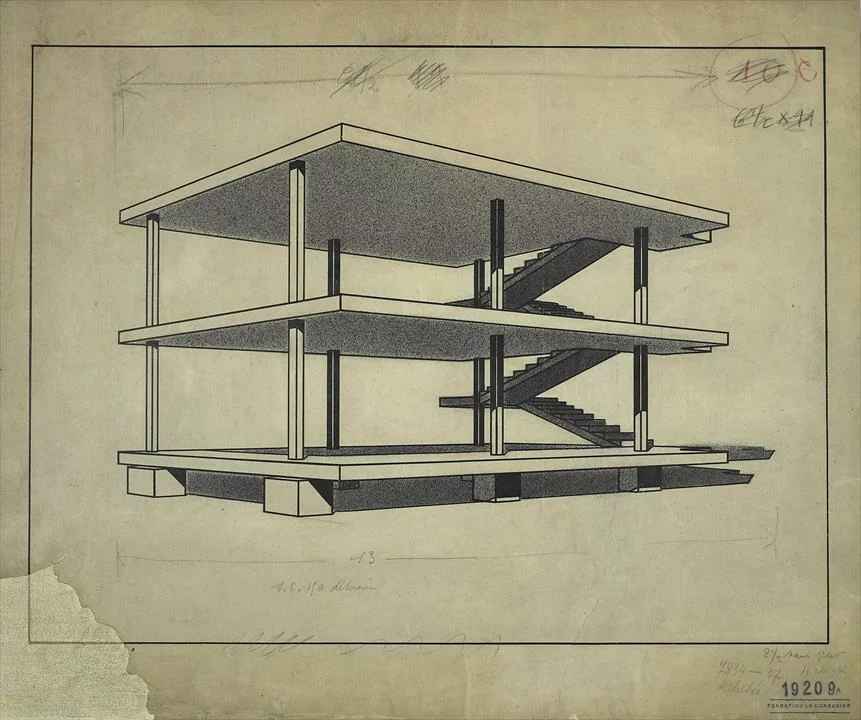
In other words, I started to think that we should explore an inductive method from the bottom to the top for the structure in contrast to the deductive Domino model where the rules are handed down from the top to the bottom. More accurately, rather than reaching conclusions from individual elements, the individual elements are assembled as individual pieces, consisting of the proposal of a different kind of logical structure or arithmetic operation. As a result of this type of thinking, this installation was named Domino 3.0. We strived to go one step further in this challenge from the intermediate Domino 2.0 announced at the same Venice Biennale in 2014 where the finish material was changed to wood veneer.
The 3D scan data of fallen trees created by the CARACOL company was used to manufacture soft joints using Thermoplastic Elastomer (TPE), and this served a pivotal role in facilitating the assembly of random fallen trees. In contrast to the hard, stiff joints of Domino 1.0 characteristic of industrialized society in which there is no followability with respect to movements, the joint system that we developed this time is extremely soft, in the same manner as human joints or the small branches on trees. This facilitates detailed responses to all types of movements, growth and changes, serving as an indicator that architecture of the future will return to being this type of soft structure.
Thus, this soft Domino 3.0 blends into forests, becoming a perfect tool to enable people to return to the forest. While Domino 1.0 was a tool that separated people from the forest and crammed them into cities, Domino 3.0 is a tool designed to reconnect people with nature, leading humankind in a completely opposite direction.

ProjectsDomino 3.0 / Generated Living Structure
 For the Venice Biennale International Architecture Exhibition 2025, held under the overarching theme of AI, we presented Domino 3.0: a house to return to the forest. The material was timber from trees uprooted and devastated by Storm Vaia in October 2018 — trees left to decay on the forest floor. Ea … Read More
ProjectsThe Cloud at Blankenese Church
 The installation “The Cloud” is the outcome of a Polish-Japanese research and workshop program conducted in 2020–2021 by Kengo Kuma & Associates and the Faculty of Architecture and Fine Arts at Andrzej Frycz Modrzewski Krakow University. Originally conceived during the pandemic and first exhibited a … Read More
ProjectsExhibition: Matter of Relationships – The Architecture of Kengo Kuma
 I have never seen architecture as a solitary object. For me, it is always part of something larger—a network of relationships between people, materials, and the environment. This exhibition, Matter of Relationships, offers a glimpse into how those connections take shape through the work of my office … Read More