
#89 August 22, 2026
Frank Stella, Red Cones, and the Global OS
The article I wrote for the August 2020 issue of DIAMOND Harvard Business Review, titled "It Is Time to Rewrite the OS of the Earth," may have received the strongest response of anything I have written.
After reading the piece, Minoru Yoshikawa, president of Toho Leo, a company known for creating green infrastructure, reached out and suggested that we start a project together to rewrite the “Global OS.” Over the six years since then, I have worked with Mr. Yoshikawa and his team on numerous concrete projects, traveling and working side by side while seriously discussing the cosmic theme of the “Global OS.”
We launched various projects with the goal of replacing the twentieth-century Global OS, which relied on architecture as a tool to manage the planet, with a new system that uses more supple tools. Through repeated experiments, we utilized flexible tools such as greenery, planting, and networks of small elements.
 Global OS Project “Stella” at Tsukiji Jam
The latest of these experiments was an event called Tsukiji JAM 2026, held on May 24 at Tsukiji Hongwanji. On the grounds of this wonderful temple designed by Chuta Ito, we designed a mobile table with the somewhat unexpected name of “STELLA.”
Made by combining two traffic cones with two elastic rubber ropes, the table embodies the philosophy of the new Global OS in many ways, including its lightness, expandability, and upcyclability. Most importantly, its name comes from the contemporary artist I deeply admire, Frank Stella (1936-2024).
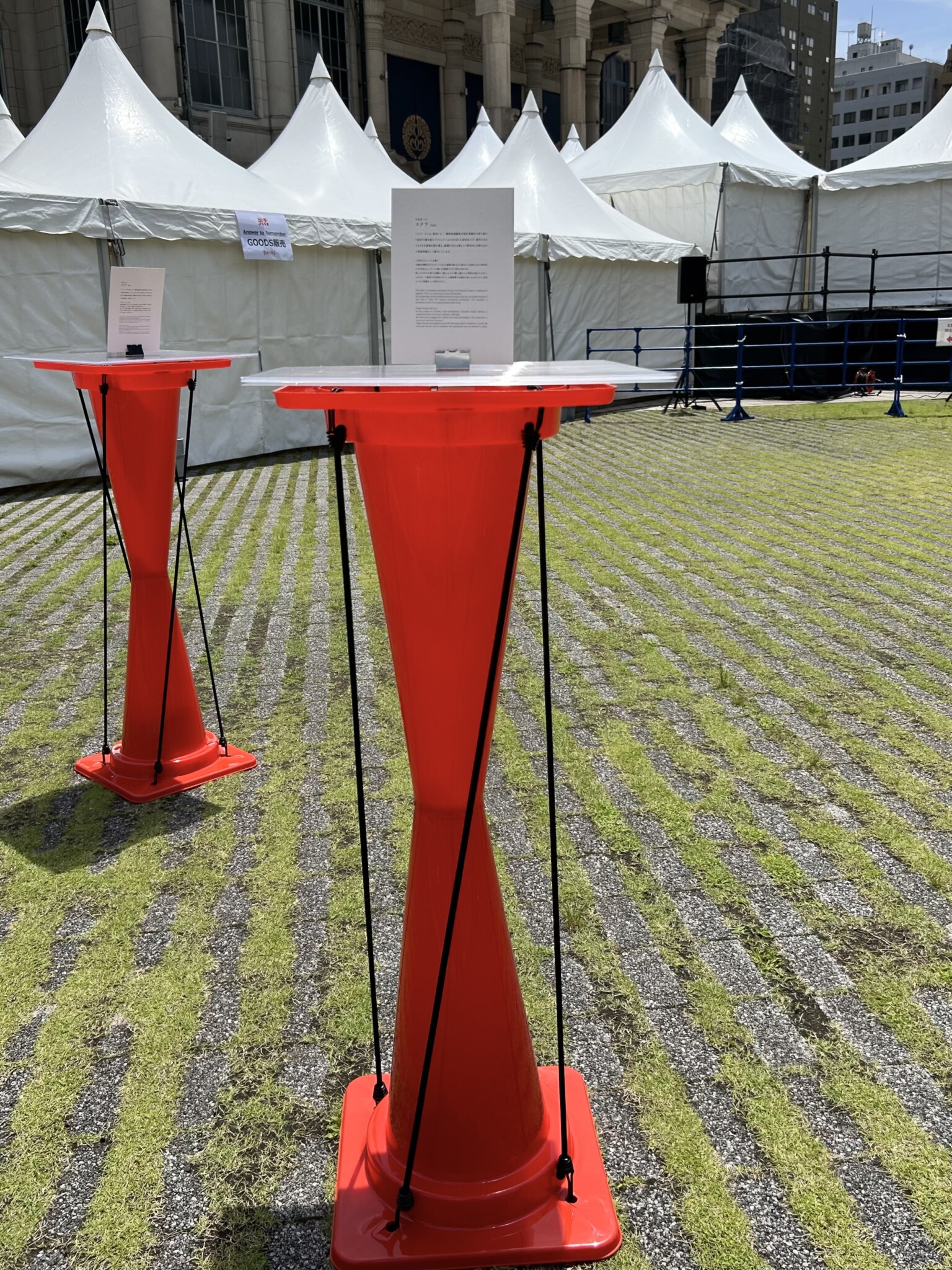 Global OS Project “Stella” at Tsukiji Jam
In 1985, while studying at Columbia University, I attended a talk by Stella at the Urban Center, a space located inside the beautiful Villard Houses designed by McKim, Mead & White. It was an eye-opening and truly special experience for me.
During the year following the Plaza Accord in September 1985, which marked a major turning point in modern history, I connected with diverse people and had a wide range of experiences in New York. I went through a personal transformation on a scale comparable to the Plaza Accord itself. Even within that dense and eventful year, Stella's lecture using traffic cones carried an extraordinary magnitude.
To begin with, I was surprised to find two bright red traffic cones set up in the salon of the Villard Houses. These cones seemed completely out of place for a superstar of minimalist abstract art, and I felt uneasy, wondering if they were perhaps an exaggerated security measure for a revered master of the art world.
Suddenly, Stella walked in, picked up a cone, and began his lecture. He continued to speak while rotating and moving the bright red cones in various ways.
Painting must regain the power to draw the viewer into its space. Stella conveyed that simple, fundamental truth. Just by placing a traffic cone on a street, those of us who feel alienated from our surroundings and wander aimlessly are suddenly drawn into the space and connected with it. We were overwhelmed by the powerful simplicity of his message that abstract painting, having reached a dead end, needed to function just like these traffic cones.
Later, I learned that this talk summarized the key points of his Charles Eliot Norton Lectures delivered two years earlier at Harvard University. Those lectures, published under the title Working Space, proved to be so significant that they are said to have altered the course of modern art history.
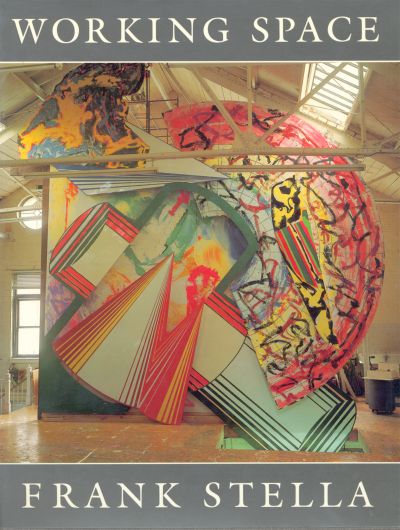 Frank Stella (1986), Working Space, Harvard University Press.
When I was asked to design drink tables for the participants of Tsukiji JAM, Stella's traffic cones suddenly came to mind. What we were aiming for in our Global OS project was never to build large new structures, but rather the exact opposite, using small elements to enter alienated spaces and actively participate in them!
Given his image as a master of minimalist abstraction, Stella's focus on traffic cones was completely unexpected and astonishing. Looking back at the history of abstract painting, however, the thick walls of minimalism might never have been broken without the impact of the traffic cone. That was how persuasive those cones were at that time.
Spanning forty years and arriving from New York, the bright red traffic cones created a striking presence in the front courtyard of Tsukiji Hongwanji, exactly as we had intended. Their pointed, bright red tips pierced through to us, drawing us directly into a whole new space.

NewsPublication Self-Building Public 2
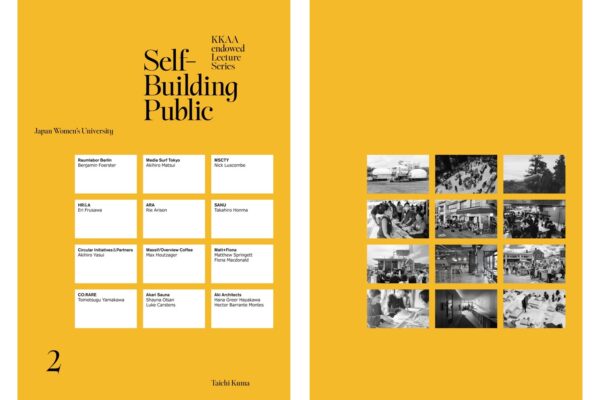 A new book based on KKAA’s endowed lecture titled Self-Building Public by Taichi Kuma, held at Japan Women’s University, has been released. This guidebook explores how to create public spaces individually, presenting twelve diverse examples of varying forms and scales in both Japanese and English. A … Read More
ProjectsGlobal OS Project “Stella” at Tsukiji Jam
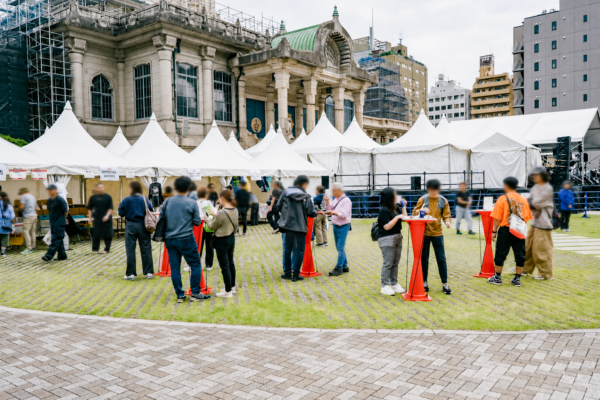 A traffic cone, ordinarily used to restrict human movement and mark boundaries, is inverted here into a small piece of furniture that generates places for people to gather. The result is a standing table. The name “Stella” derives from Frank Stella, an artist we deeply admire, who used cones to arti … Read More
ProjectsGlobal OS The Three Sacred Treasures for Yaesu St. Parklet
 To get out of the concrete box and enjoy the outdoors more, we redesigned three Japanese typologies "Casa" (umbrella,) "hibachi" (fire bowl,) and "tatami" (floor mat,) and named them the "Three Sacred Treasures". The solar-powered casa provides warm light when it gets dark, and when connected with a … Read More
ProjectsGlobal OS Long Table & Roof
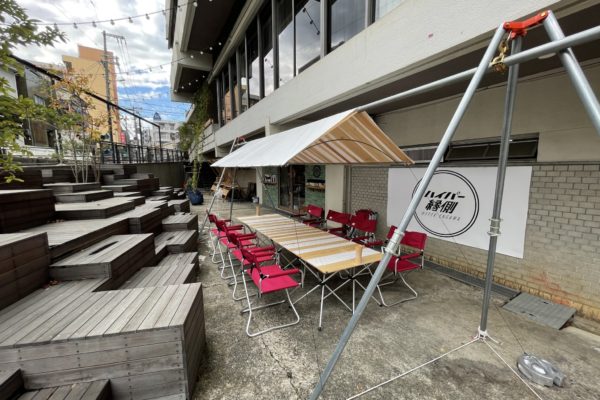 This is a social experiment to explore new lifestyles post-Covid, initiated by President Minoru Yoshikawa of Toho Leo, who resonated with Kuma's interview in the August 2020 issue of Harvard Business Review, "Now is the time to rewrite the operating system of the Earth.” The project investigates how … Read More